How can evaluating academic
characteristics promote success in school?
As I finish up this course, I've been reflecting on this guiding question with a new perspective. I'll get back to the guiding question in a bit, but first I think we need to talk about how we evaluate academic characteristics. The answer to that question lies in assessment. When we assess students, we are looking at a variety of areas, but essentially we are trying to figure out one of two things. First, is the student learning what they are supposed to be learning? Second, if they are not, what is getting in the way of that learning?
I suppose there are those who view assessment as a negative thing, but assessment doesn't have to be a "bad word". In fact, assessment can and should be a valuable tool for educators to pinpoint their students' strengths and weaknesses. When we do this, we become better able to provide targeted, meaningful instruction for our students, as well as intervention if necessary.
The first objective of this course was as follows:
1) gain knowledge of the
practices and procedures related to evaluating educationally-related
disabilities and other academic characteristics.
To meet this objective, we had a
lengthy but informative discussion about the referral process for special
education, including the role that RTI (Response to Intervention) should be
playing in helping to identify students with a potential disability. We learned
about the three gates of special education: Is there a disability; Is there
adverse effect; and to the students require specialized instruction? We also
talked about the differences between an IEP and a 504 plan, and the legal
aspects of both services. I was really happy to get all of this information,
because I had "learned" it in other classes, but I feel like I
understand it all so much better now.
Another big issue pertaining to the
practices and procedures of special education is confidentiality. In fact, one
of the common threads running throughout this course was the idea of confidentiality,
professionalism, and respect. We learned that there are both moral and legal
reasons to keep student information confidential.
The second
course objective was as follows:
2) acquire strategies for:
a. diagnosing specific characteristics
that impact learning;
b. understanding the influence
of academic characteristics on learning;
c. developing individualized
and measureable goals and objectives;
d. matching
strategies with specific student characteristics.
e. analyze
the effectiveness of instructional strategies.
To meet this objective, we did a few
case studies of mock students. We needed to look at a student's description,
some of his or her various assessment scores, and consider the behaviors they
were exhibiting in the learning environment. Then we had to come up with
potential strategies for giving these students the interventions or services
they needed. This was valuable practice for me, and I appreciated that I could
practice evaluating these phantom students in a low-stakes environment like
this.
I gained a lot from our learning in
writing IEPs, including how to write up present levels of performance (for
which we need good data--ie. assessments), how to write goals and objectives,
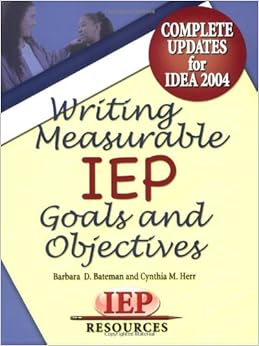
and the importance of tracking data. The book, Writing Measurable IEP Goals
and Objectives was incredibly helpful and will be a good resource down
the line, as well.
The third course objective was as
follows:
3) demonstrate a grounded perspective
about evaluation that can be used to improve student learning.
To meet this objective, we talked
about some of the most common forms of assessments used in special education.
We worked with partners to both take and administer the Woodcock-Johnson IV
Achievement test. I feel like this was one of the most informative aspects of
the course. Being able to go through the process from start to finish,
including what to do after the results are in, will prove to be immensely
helpful in my future role as an educator.
A few years ago, before I began my
journey into the field of education, I sort of just thought that assessment =
tests. Thankfully I've learned along the way just how valuable
assessment/evaluation is. You must get to know your students, what skills they
have and what they are missing (and why) before you know how you can teach them
best. If our goal is to provide every student with what he or she needs, then
we must first find out what that is!
The final course objective was as
follows:
4) construct a vision of the
symbiotic relationship of evaluation and strategies.
This course
really hit home the notion that assessment done well is incredibly important in
the education process. Just as important as getting data, though, is how we use
that data. Will we use it to guide our instruction? Will we use it to provide services
for our student; to show that a child does, indeed, have a disability that has
been holding him or her back? Knowledge is so powerful, and once we know where
our students are coming from, only then can we provide them with the support
they need.
Evaluation/assessment
and strategies go hand-in-hand. We assess, in large part, to help us determine
our strategies. After some time has passed since we've been implementing those
strategies, we should go back to evaluation again. This time, we want to know
if our strategies are working, and if so, that's great! If not, we should
reconsider our strategy and try something different. Evaluation and strategies
are, indeed, symbiotic in that each informs the other about which direction
they will take next.
This brings
me back to the guiding question, which asked how evaluation can promote success
in school. Evaluation is an integral tool in an educator's toolbox. Without it,
we cannot make informed decisions for our students.

No comments:
Post a Comment