This was the guiding question for the course, Foundations of Inclusive Practice. Our course objectives that were outlined in the syllabus are as follows:
Students will engage in an examination of the guiding question through academic study, personal reflection, and course assignments. In doing this, students will 1) gain knowledge of disability, special needs, and difference, specifically through the study of characteristics of individuals experiencing learning difficulties; 2) acquire strategies for designing inclusive learning environments; 3) demonstrate a grounded perspective about the issues and arguments related to inclusion; 4) construct a vision of themselves as inclusive educators.
Part of our time in this course was spent learning about Universal Design for Learning (UDL). We used the book, Universal Design for Learning in the Classroom by editors Hall, Meyer & Rose to gain a better understanding of UDL principles and how to use them in the classroom.
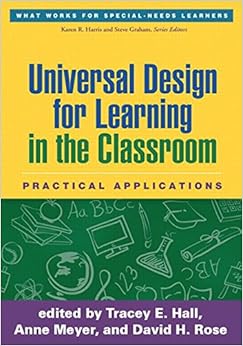
There are three main UDL principles: Multiple Means of Representation, Multiple Means of Action & Expression, and Multiple Means of Engagement. The idea is that, using UDL principles, educators can design lesson plans that "consider the broadest range of learners from the outset," (Hall, Meyer & Rose, 2012, p. 20). Through UDL planning, then, educators can design their lesson for inclusion without having to make time-consuming accommodations for each and every student. UDL offers teachers a realistic way to make the curriculum engaging and available to all their students.
At our first class meeting in February, one of the things we were asked to consider was our thoughts regarding labeling students with disabilities. We were given some time to process our thoughts and to put them down on paper. I've included those thoughts below:
Given the history of discriminatory practices toward exceptional students, and also considering the harmful effects that negative language has on students, I can understand the reluctance some may have to label and categorize students and their disabilities. If, however, there are highly trained, sensitive support personnel working with these students, the negative effects of categorization can be kept to a minimum. Labels can be useful when it comes to finding a starting point for a child, but the solution and should never be a one size fits all sort of thing.
The reality of school funding is that there is rarely enough money to go around, so categorization can be useful in determining exactly where to put special education dollars. Knowing the specific needs of their special education students helps administrators target spending in the areas where they will get the most bang for their buck.
In the end, I think there is a need for balance when it comes to labeling students. We must balance the needs of all our students with the realities of limited time, limited resources, and legal responsibilities.
Now that we've come to the conclusion of this course, I still share the view that labels are a somewhat "necessary evil" in special education. I know now that disability labels are how schools determine eligibility through IDEA, and that without a label, services through an IEP or a 504 plan are impossible. I still believe that labeling disabilities is only one point of access in completing the whole picture about the whole child. For instance, a general education teacher may hear at the beginning of the year that her student has a specific learning disability in math. However, knowing the disability alone does not give her the whole story, and unless she gets to know this kiddo, she will never know that his art talent is beyond amazing and that she might be able to use his art skills somehow to facilitate a higher understanding in math.
Other disabilities can come with a stigma that teachers may not be aware they are affected by. If a student has a behavioral disability, for instance, his or her relationship with the teacher might be strained right off the bat if the teacher has preconceived notions about that disability. On the other hand, a some learning disabilities don't necessarily come with the same stigma, and these students would probably be given the benefit of the doubt more easily when it comes to their struggles (ie, dyslexia).
During this course, one of my tasks was to spent twenty hours observing with a special educator in a local elementary school. Part of my focus during this time was to examine the accommodations, goals, and experiences of a student on an IEP. I also spent time focusing on a student needing support services but who did not have an IEP or 504 plan. During my time at this school, I got to see RTI (Response to Intervention) in action, and I was impressed by the RTI philosophy of responding to all students' needs as they arise before waiting for an even bigger gap in learning to take action.
The following is an excerpt from the Foundations of Inclusive Practice course description:
In particular, we examine the means of serving youth with special needs within a school, including classroom-based interventions, the referral process, identifying accommodations, and designs for inclusive education.
My learning in these areas was varied. I learned that classroom-based interventions can often be solved through the use of UDL principles during lesson design and planning. I also learned that students can be referred to special education services by a teacher, parent, or doctor, but that NO special education evaluation can be conducted without the consent of the student's parents or guardian. Referrals should not occur unless a history of prior interventions taken can be proven and shown not to have worked.
Identifying accommodations for students receiving special education services should be the responsibility of all members of the child's support team: special educator, general classroom educator, parents, etc., including the student him/herself. Using UDL principles in lesson design allows for a strengthening of the inclusive classroom environment and can give students greater access to grade-level curriculum.
One of my learning strengths is in the linguistic/verbal area, so the reading was probably one of the biggest contributing factors to my learning in this course. One of our books, Learners with Mild Disabilities by Eileen Raymond, was helpful in understanding the myriad of disabilities that can be present in students but don't appear noticeable to the average person. To that end, I'll share the presentation I developed, along with the help of two other classmates, to shed some light on Attention Disorders, which was the focus of Chapter 7 in the book.
Going forward, both as a student and as an educator, I expect to learn a great deal more about inclusion and exceptional students. For now, though, I'm happy to have the foundation of understanding I've gained through this course.

No comments:
Post a Comment