- How does literacy impact learning?
Students will engage in an examination of the guiding question through academic study, personal reflection, and course assignments. In doing this, students will
1) gain knowledge of the theories and research related to literacy development, student literacy profiles, literacy struggles faced by students, literacy assessment, and literacy strategies;
2) acquire strategies for:
a. examining the development of literacy;
b. diagnosing literacy difficulties;
c. developing individualized literacy strategies;
d. monitoring literacy skills over time.
3) demonstrate a grounded perspective about the impact of literacy on a student’s ability to be successful in school.
4) construct a vision of literacy as a variety of interdependent skills.
So, after engaging in "an examination of the guiding question through academic study, personal reflection, and course assignments," I have a much deeper understanding of the ways in which literacy impacts learning.
At the heart of it all, is the idea that literacy is the foundation upon which almost all other areas of study are built. Without strong literacy skills, a student cannot be expected to fully comprehend her 5th grade social studies text on explorers or to articulately express her thoughts in writing on the latest chapter in Shiloh. Another student may take a strong interest in dinosaurs, but be resigned to looking at pictures in books rather than reading higher level text because his reading development has stalled. Literacy is the key to opening up other worlds of learning for children and adults, alike. With strong literacy skills and access to the written word, we can all become life-long learners.
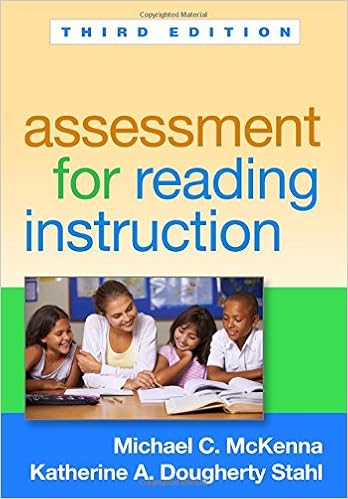
As the course title would suggest, much of our learning in class was spent on interventions in literacy. We learned how to spot areas of weak skills through quality and appropriate assessments, and subsequently, how to support those weaker areas through targeted instruction. We used a fabulous text called Assessment for Reading Instruction, which is full of assessments for all areas of literacy development, including decoding, fluency, and comprehension.
One of the biggest learning opportunities for me during this course was our time spent in evaluating a literacy program. We could choose either one for core instruction or one for interventions. I focused on the K-2 program called SuperKids, a fun, really engaging core reading program that also contains embedded ideas for differentiated and tiered instruction. I created a Prezi as a part of my evaluation.
One of the key take-aways I have learned in this course is that assessment starts with the direct observation of the learner. The farther away from the learner you get, the less reliable your assessment is. Also, the environment the learner is in during assessment is hugely important. The majority of assessment must be embedded in the natural learning environment, or your results will not be a strong reflection of your student.
Another important thing to note: Reading is a personal thing. It means different things to different people, and for some it represents great struggle and sometimes shame. As educators, we must acknowledge this before we can even try to make headway on teaching skills. We have to find a way to connect with our learners and meet them where they're at. Let them see that they are in a safe learning environment, and that they are supported in their interests and goals. I cannot emphasize enough how important that connection is between the educator and student.
We didn't talk much about this in class, at least not that I can remember, but this leads me to another key area of literacy intervention and education: creating a literacy-rich classroom environment. This is crazy important for developing students who are READERS! Some elements of a literacy-rich environment include but are not limited to:
- Child-made books (individual and group-process made)
- Teacher-made books
- Books made by the class based on shared experiences
- Picture books
- Children's magazines
- Pillows, rugs, rockers (to create a soft, comfortable area)
- Flannel board with stories children can re-tell
- Familiar books that children can 'read' from memory
- Pictures of children reading
- Story tapes
- Books for reference
- Dictation taken by the Teacher and posted on large sheets of easel paper.
- Quotes on children's artwork, again word for word. Ask the child if he/she would like to tell you about his/her work.
- Ask if they would like for you to write it down, and where they want it on the picture. What children say about their own work tells us what they are thinking and feeling and their views on the world. It is also a great communication enhancer between parent and child.
- Items labeled throughout the classroom.
Again, this is to give children the message that everything has a set of recognizable, common symbols that are written down that universally identify it. Don't label everything, or it becomes too visually stimulating. (http://www.childcarelounge.com/literacy/print-rich-class.php)
At some point during my Internet travels, I came across the name Fred Steele, who did some work in the 70's researching the importance of environment in education. He highlighted six key elements which should be considered in a classroom environment, and I'm writing them here for "safe-keeping". (http://www.facultyportal.cehs.wvu.edu/r/download/127664)
- Security and Shelter: Students should have a warm, safe place to escape from noise and other environmental distractions.
- Social Contact: how much, who, and when
- Symbolic Identification: "What does this classroom tell us about the students?--their interests, activities, backgrounds, accomplishments and preferences"
- Task Instrumentality: can the tasks the students are being asked to do be completed within the current environment?
- Pleasure: Is the environment attractive and pleasing?
- Growth: Does the environment foster growth? I take this to mean both cognitive and social growth.
That last bit was perhaps somewhat of a tangent, but I know I'll be happy to have it later. To get back to the guiding question, though, literacy is the main tool through which we access almost all other forms of learning. Without literacy, our capacity for understanding the world around us is incredibly limited and our potential for growth is hindered.

No comments:
Post a Comment